When a Powerful Tool Starts to Look Like a Universal One
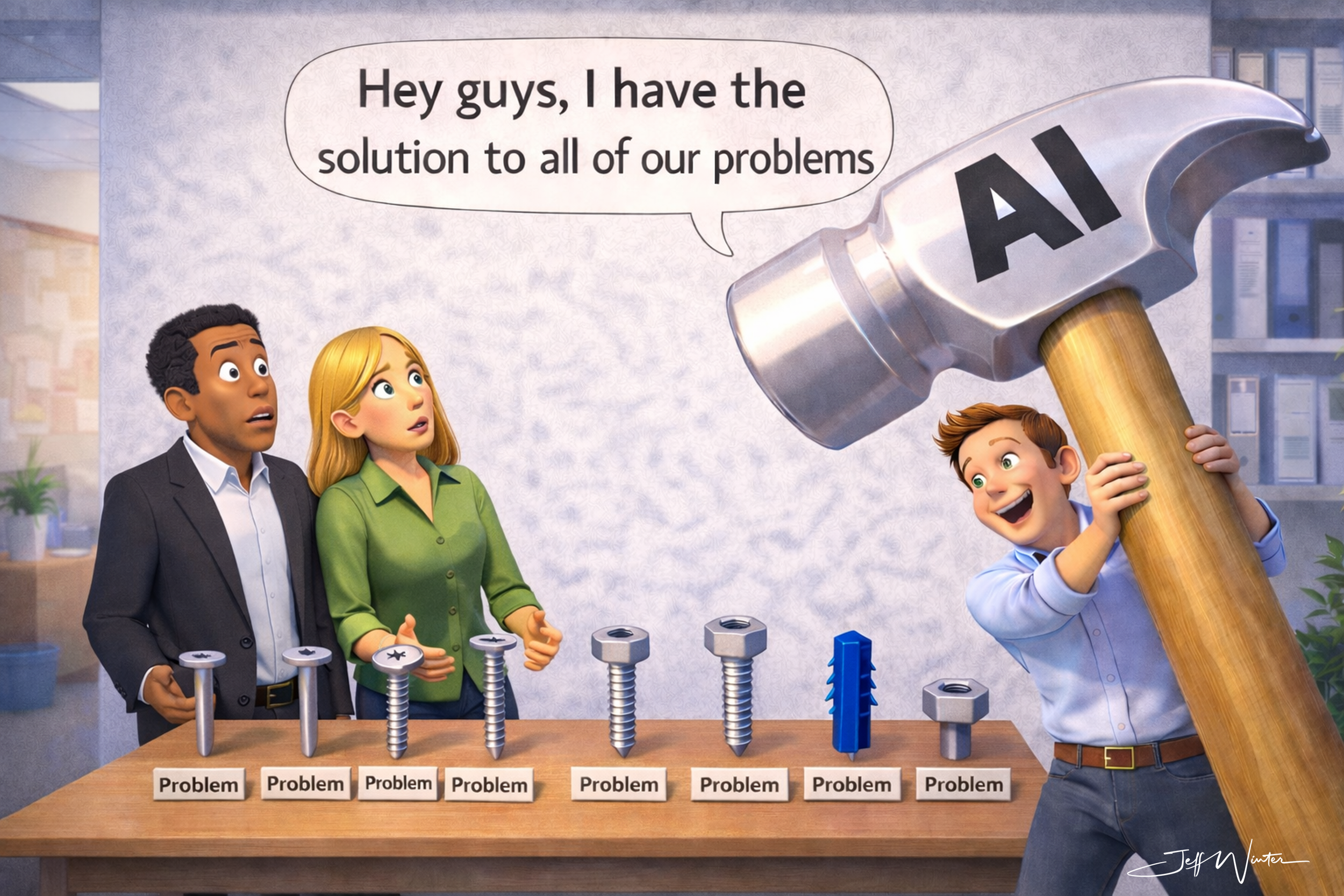
“Hey guys, I have the solution to all of our problems.” That sentence is doing a lot of work in 2026.
It shows up in executive meetings, strategy decks, vendor pitches, and internal emails. Sometimes it is said explicitly. More often, it is implied through urgency, confidence, and speed. Artificial intelligence has become the most powerful tool most organizations have ever picked up, and with that power comes a familiar risk.
The moment a tool feels transformative, everything nearby begins to look like it should yield to it. Right now, AI is that tool. It is fast, visible, and increasingly accessible. It promises scale, efficiency, and competitive advantage. But as it enters more conversations, something subtle happens. The discussion shifts away from purpose and toward deployment. Teams move quickly from What are we trying to do? to How fast can we roll this out? We are not overusing AI. We are overestimating where it belongs. AI is being treated not just as a powerful capability, but as a universal one. And that distinction is where many organizations are getting into trouble.
Why AI Is Not Just Another “Shiny Object”
Every decade brings its own set of transformative technologies. Cloud, mobile, IoT, analytics, and automation all arrived with significant promise, and many organizations struggled with how to adopt them effectively. AI, however, is fundamentally different from those earlier waves. Those technologies changed how work was done. AI changes how decisions are made.
By definition, AI introduces intelligence into systems. That means it does not simply execute tasks faster or digitize existing workflows. It participates in analysis, inference, recommendation, and, increasingly, action. As a result, it touches areas that were previously the exclusive domain of human judgment. That is what makes AI so compelling, and also what makes it risky. When intelligence enters the system, it begins to shape behavior. It influences priorities. It changes how people trust outputs and defer authority. In many organizations, the presence of AI creates an unspoken assumption that thinking has already happened somewhere else.
This is where problems begin to surface. AI does not eliminate ambiguity. It reacts to it. If goals are unclear, AI optimizes the wrong thing. If ownership is fuzzy, AI produces outputs no one is accountable for. If incentives conflict, AI accelerates those conflicts rather than resolving them. Unlike past technologies, AI does not quietly sit in the background. It forces organizations to confront the quality of their decisions, not just the efficiency of their processes.
Where AI Works & Where It Consistently Doesn’t
Much of the confusion around AI comes from expecting it to perform equally well across very different types of problems. In practice, its strengths and limitations are surprisingly consistent. AI tends to deliver meaningful value when:
The problem is well framed and bounded
Inputs are reliable and reasonably structured
Decision ownership is clear
The goal is to support or accelerate human judgment
In these conditions, AI excels at identifying patterns across large data sets, summarizing and generating information, and reducing the time between signal and insight. AI struggles when:
Ownership and accountability are unclear
Processes are broken or poorly understood
Trade-offs are political or incentive-driven
The organization expects intelligence to substitute for alignment
When AI is applied in environments that lack clarity, it often exposes those weaknesses rather than fixing them. Teams deploy models, automate workflows, and integrate tools, only to find that outcomes remain unchanged. The technology works. The system around it does not. This is why many AI initiatives stall after promising pilots. The tool performs as designed, but the surrounding conditions prevent it from creating durable value.
Precision, Not Pervasiveness, Is the Real Advantage
The organizations seeing sustained impact from AI are not the ones applying it everywhere. They are the ones applying it deliberately. They invest time upfront in problem framing. They distinguish between issues that require intelligence and those that require leadership, process change, or incentive realignment. They clean up decision rights before automating decisions. They understand that intelligence amplifies whatever structure already exists.
Most importantly, they resist the temptation to treat AI as a shortcut around organizational work. AI does not replace judgment. It pressures it. It does not create alignment. It exposes the lack of it. And it does not resolve trade-offs. It forces them into the open. Before scaling AI, these organizations ask a more fundamental question: What kind of problem is this, really? If the answer is confusion, misalignment, or unclear accountability, then no amount of intelligence will fix it. Putting AI on top of those conditions does not make them disappear. It simply makes them harder to ignore.
AI is an extraordinary tool. But power requires discernment. The organizations that get this right are not chasing a universal solution. They are choosing the right tool for the job, and doing the harder work that makes intelligence worth deploying in the first place.