You Can’t Lead at Everything
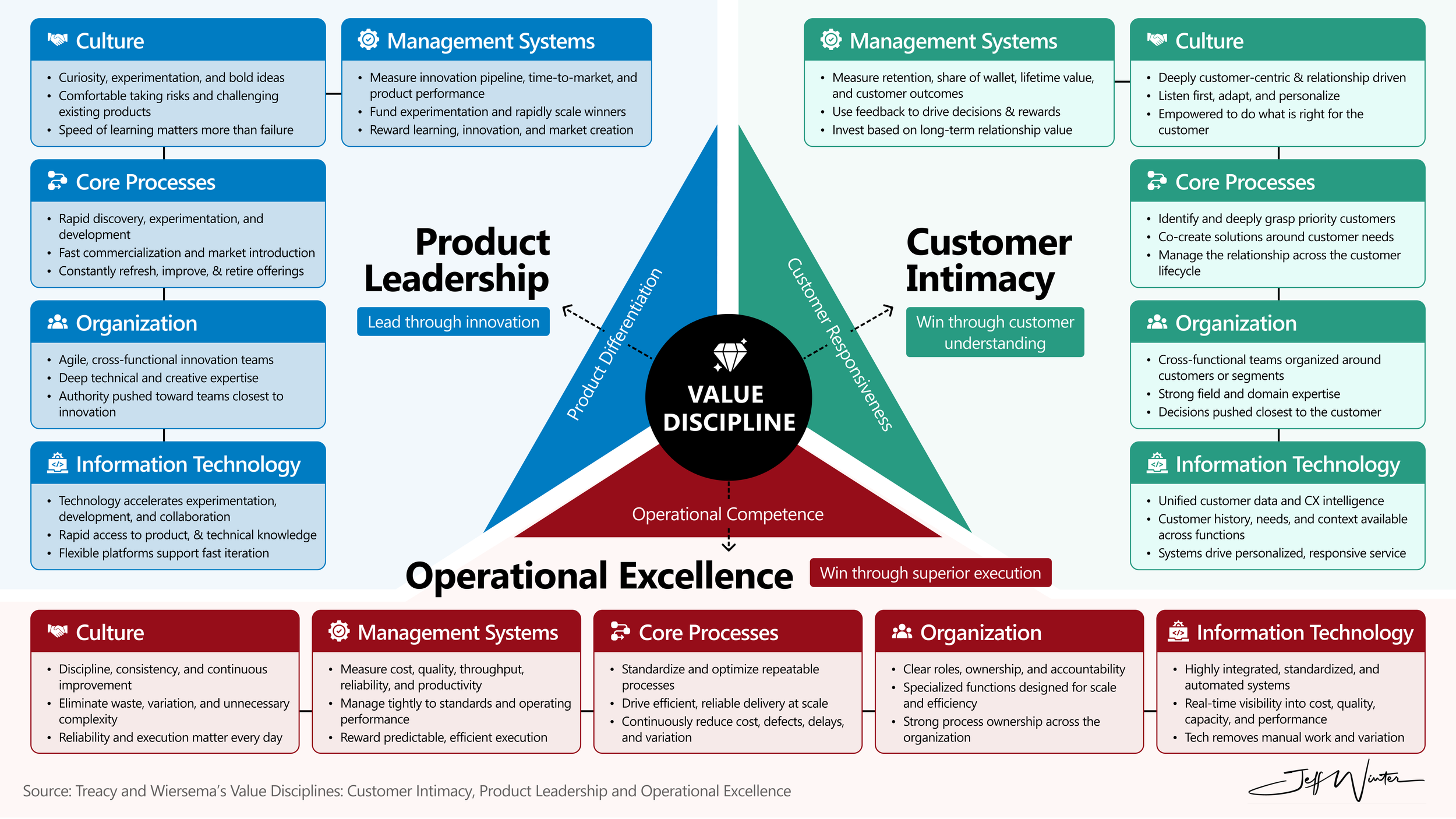
Treacy and Wiersema’s Value Disciplines is more than 30 years old, and I keep thinking it may be more useful now than when it was written. I am not completely sure whether that says something good about the framework or something slightly depressing about how little our strategy problems have changed.
Michael Treacy and Fred Wiersema introduced the idea in their 1993 Harvard Business Review article, “Customer Intimacy and Other Value Disciplines”. Their basic argument was that companies tend to create superior customer value through one of three disciplines:
Product Leadership is about creating offerings that customers see as better, newer, or meaningfully different.
Customer Intimacy is about understanding particular customers or segments extremely well and adapting around what they actually need.
Operational Excellence is about reliability, efficiency, consistency, convenience, and economics.
You still have to be competent across all three, obviously, but companies that really stand out tend to build a disproportionate advantage around one. And every company reads those three descriptions and thinks exactly the same thing…
YES!!! We want all of them, obviously!
I get it! I want a restaurant with incredible food, low prices, no wait, unlimited choices, and somehow a staff that remembers exactly what I ordered eight months ago. I also want the calories not to count! 🤣
The customer is allowed to want everything. Why wouldn’t they? But, the company still has to decide what it is actually going to organize around.
This got more interesting for me later in my career
I spent a lot of my career closer to sales and marketing, so my natural instinct has always been to solve the customer problem. If somebody needs something and we can reasonably make it happen, figure it out. I still believe that. Businesses can become strangely proud of their internal processes while customers are standing outside wondering why doing business with them is so difficult.
But I understand the other side much more than I used to. I have sat through plenty of conversations where somebody says, “It is just a small customization.” Sometimes it really is small. Sometimes it is absolutely the right decision. But the definition of “small” changes depending on where you sit.
Sales sees a customer need and possibly a deal. Engineering sees another variation. Operations sees something different to build. Somebody has to document it. Somebody eventually supports it. Three years later, another person finds this weird configuration buried in a system and asks why it exists. The answer is often wonderfully vague: “There was a customer who needed that once.”
I have heard versions of that sentence more times than I can count. Customer Intimacy looks at the original decision and says, “Of course we should do it. This is how we differentiate.” Operational Excellence looks at the accumulation of those decisions and says, “If we keep doing this, eventually nobody will understand how this place works.” Product Leadership may be wondering why engineering is spending time modifying something old instead of creating something new.
The weird thing is that all three people can be right. That is probably my favorite part of this framework. It explains something I have come to believe pretty strongly: a lot of what companies call execution problems are actually strategy disagreements that nobody resolved at the top. So the disagreement gets pushed downward and employees are left to negotiate it one decision at a time. Sales gets told to be responsive. Operations gets told to reduce variation. Innovation gets told to experiment. Finance wants predictability. IT wants standardization. Customer teams want flexibility. Everyone behaves rationally, and somehow the combined result still feels irrational.
We have an addition problem
The other reason I like this framework is that companies are remarkably good at adding priorities. Ask what matters next year and you can almost predict the answers: growth, margin, innovation, AI, customer experience, talent, productivity, resilience, cybersecurity, new markets, better data, cost reduction, automation, speed. Somewhere around item fourteen, somebody usually remembers simplification, which is funny when you think about it.
None of these are bad ideas, and that is the main problem. Strategy would be much easier if organizations mostly generated terrible ideas. Give me twenty priorities where seventeen are obviously ridiculous and we could be finished by lunch. The actual problem is that there may be twenty useful things we could do, ten we probably should do, five that could genuinely change the business, and enough money, talent, and attention to do maybe three really well.
I think we underestimate how much of strategy is deciding between good things. Treacy and Wiersema’s original work went beyond simply labeling the three disciplines. They argued that the operating model needs to reinforce the choice: the processes, management systems, structure, technology, culture, and behaviors all have to support the way you intend to win.
If you say Product Leadership, what happens when an experiment fails? If you say Customer Intimacy, how much freedom actually exists near the customer? If you say Operational Excellence, how many exceptions have accumulated over ten or twenty years?
Companies rarely become complicated because someone deliberately decided complexity was a brilliant strategy. It happens one reasonable exception at a time. It is a bit like the junk drawer in my kitchen. Nobody planned a drawer containing six dead batteries, three mystery keys, a measuring tape, expired coupons, and one tiny screwdriver. Every item had a perfectly logical reason for going in there. The drawer as a whole makes absolutely no sense. Yet, organizations do this too.
And then 2026 made the menu much bigger
AI makes this framework even more relevant because it is genuinely making all three disciplines better at once. It can accelerate product development, personalize interactions, automate work, improve forecasting, assist engineers, detect quality problems, optimize operations, and reduce the cost of things that used to require a lot more human effort.
The NIST 2026 roadmap for AI and machine learning in smart manufacturing talks about the opportunity around efficiency, adaptability, and autonomy, while also pointing to very practical problems around data, interoperability, integration, reliability, and trust. Deloitte’s 2026 Manufacturing Industry Outlook shows manufacturers dealing with AI, productivity, resilience, talent, smart manufacturing, and other priorities simultaneously. So maybe some traditional trade-offs really are shrinking. I think they are. AI can make personalization cheaper. Automation can improve quality while reducing cost. Better digital engineering can speed innovation. But I do not think the need for choice disappears. If anything, I think it gets harder.
AI increases the importance of strategy because it massively increases the number of things that are now plausible. Technology used to eliminate ideas for us. Too expensive. Too difficult. Impossible to scale. Now many more ideas survive that first test, which means somebody has to decide which ones actually deserve people, capital, data, and attention. I see this constantly with AI use-case lists. Twenty ideas become fifty surprisingly quickly, and somehow almost every one is classified as “high value.” We may have artificial intelligence before we figure out artificial prioritization.
That is why I would use Value Disciplines a little differently today. I would not start by asking a leadership team which of the three boxes they belong in. That tends to end with everyone deciding they are somehow all three. I would ask: When a customer has several legitimate alternatives, why should they choose us?
Then keep following that answer. What must we be unusually good at? Where should we invest more heavily? Where should we allow flexibility? Where should we hate variation? Which technology investments strengthen that advantage? And the question I think matters most: what should we deliberately do less of because something else matters more? That is the part I have grown to appreciate. Strategy is not only choosing what deserves attention. It is accepting that some perfectly good ideas will get less of it. Every company wants all three, and every company should improve all three. But improvement everywhere is not the same as advantage somewhere.
Be credible in all three. Be unmistakable in one.
References:
Shepley, S., Morehouse, J., Hardin, K., & Dwivedi, K. (2025, November 13). 2026 manufacturing industry outlook. Deloitte Insights. https://www.deloitte.com/us/en/insights/industry/manufacturing-industrial-products/manufacturing-industry-outlook.html
Treacy, M., & Wiersema, F. (1993). Customer intimacy and other value disciplines. Harvard Business Review, 71(1), 84–93. https://hbr.org/1993/01/customer-intimacy-and-other-value-disciplines
Vogl, G., Cornelius, A., & Jia, X. (2026). 2026 roadmap on artificial intelligence and machine learning for smart manufacturing. IOP Publishing Ltd. https://www.nist.gov/publications/2026-roadmap-artificial-intelligence-and-machine-learning-smart-manufacturing