The AI Map Nobody Really Agrees On

Which AI terms even deserved a box?
I started with a question that sounded simple, which is probably where I made my first mistake! 🤣
How do all these regularly talked-about types of AI relate to each other?
The seven terms I settled on were Consumer AI, Enterprise AI, Generative AI, Agentic AI, Traditional ML, Industrial AI, and Physical AI. Some are common enough now that they show up everywhere: analyst reports, product launches, strategy decks, conference keynotes, vendor booths, and LinkedIn posts written late at night by someone who definitely meant to go to bed 45 minutes earlier (Yes, I am guilty of all of these…)
The hard part was choosing the terms in the first place. Generative AI is clearly mainstream, but getting a little dated already. Enterprise AI is common, although it gets used to describe everything from copilots to forecasting models to transformation programs with suspiciously round savings targets. Traditional ML is older, less talked about now, and still doing a huge amount of work while everyone else argues about agents like it is a family Thanksgiving debate where nobody remembered to bring the facts.
Other terms are still forming in public. Physical AI is becoming more common around robotics, autonomy, embodied systems, sensors, vehicles, and machines that act in the real world. Agentic AI is suddenly everywhere, although sometimes it means real multi-step autonomy and sometimes it means a chatbot with a workflow button. I know I am missing others too, including edge AI, multimodal AI, symbolic AI, embedded AI, operational AI, autonomous AI, robotics AI, AI infrastructure, causal AI, and AI for science. But those just wern’t big enough for me to include at this time.
I picked these seven because they helped me answer the question I really cared about: when someone says “enterprise AI,” “industrial AI,” or “physical AI,” are they describing the buyer, the technology, the use case, the operating environment, or just a different angle on the same tangled thing?
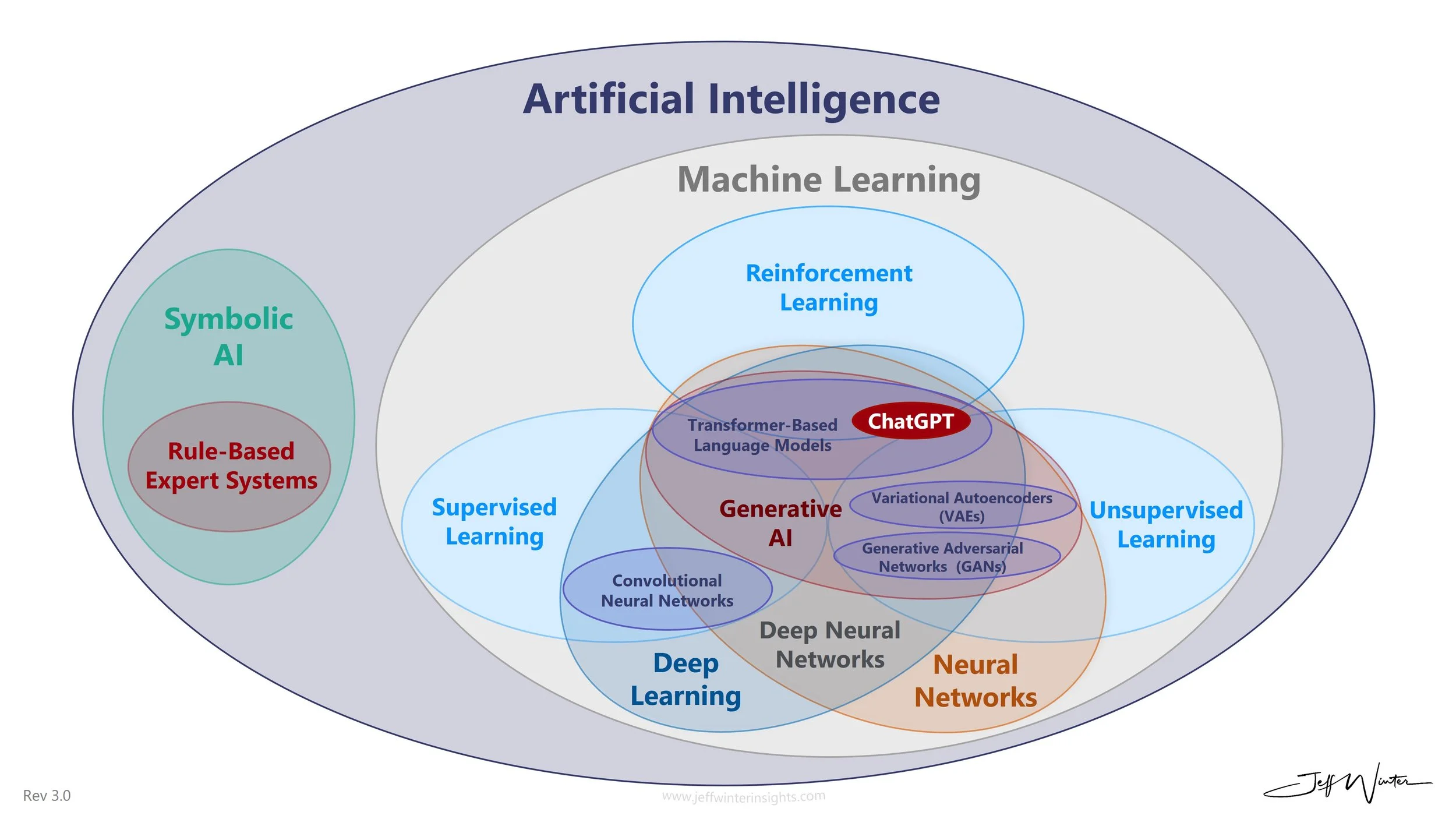
I wrote about a related question in my earlier article, “Where Does ChatGPT Fit in the Field of AI?”. That article was more of a technical family tree covering AI, symbolic AI, machine learning, deep learning, generative AI, and where ChatGPT fits into that lineage. This new diagram has a different job. It looks at the market-facing and operating-model-facing terms people use in business, manufacturing, software, strategy, and operations.
What kind of category is each term?
The biggest choice I made was treating Consumer AI and Enterprise AI as the two large surfaces. They describe audiences, buyers, usage patterns, commercial models, data environments, and governance expectations.
Consumer AI means AI built primarily for individuals using it in their personal lives. This includes chat assistants, AI search, image tools, video tools, tutors, shopping assistants, personal finance helpers, health apps, creative tools, etc. The defining feature is that the user is usually a person acting as themselves, using their own data, preferences, subscriptions, and personal workflows. Menlo Ventures estimated consumer AI at roughly 1.7 to 1.8 billion global users and about $12 billion in spending, with only around 3% of users paying for premium services. That is a massive usage surface with a strangely immature business model. A billion-plus users and only a small percentage paying feels both inevitable and fragile, like building a skyscraper on top of free trial behavior.
Enterprise AI means AI used by organizations to improve work, decisions, processes, products, customer experiences, operations, or business performance. This includes AI in sales, service, software development, finance, HR, legal, cybersecurity, analytics, procurement, operations, supply chain, knowledge management, internal workflow automation, among many other things. The defining feature is that the AI has to live inside an organization, which means it has to deal with permissions, security, governance, compliance, integration, procurement, training, support, and the challenges of internal ownership. IDC estimated that global enterprises would invest $307 billion in AI solutions in 2025, rising to $632 billion by 2028. I made Enterprise AI the largest surface because the paid surface area is enormous, even when maturity is uneven and half the company is still trying to figure out what to do with it.
Traditional Machine Learning means the older, proven family of AI techniques that learn patterns from data and then use those patterns to classify, predict, rank, detect, recommend, or optimize. This includes models for fraud detection, recommendation engines, churn prediction, pricing, demand forecasting, anomaly detection, quality inspection, predictive maintenance, customer segmentation, risk scoring, and cybersecurity detection. MIT Sloan describes machine learning as a subfield of AI that gives computers the ability to learn without being explicitly programmed. I call it “traditional” only because the AI conversation has shifted so hard toward generative AI, agents, and copilots. Traditional ML still runs quietly under a huge amount of modern software. It has the personality of a dependable accountant who also happens to run half the internet. It rarely gets invited to the keynote anymore, although it still has the keys to the building.
Generative AI means AI that creates new content or outputs based on patterns learned from large amounts of data. It can generate text, images, code, audio, video, synthetic data, summaries, plans, answers, and increasingly the natural-language interfaces people use to interact with software. The defining feature is that it produces something new rather than only predicting a score, classifying an event, or ranking a list. Menlo Ventures estimated enterprise generative AI spending at $37 billion in 2025, up from $11.5 billion in 2024. I drew GenAI broadly across consumer and enterprise because it has become the most visible experience of AI. It is the part people screenshot, argue with, laugh at, and regularly accuse of being either genius or nonsense within the same five-minute span. Personally, this is the type of AI I use ALL THE TIME!
Agentic AI means AI that can pursue a goal through multiple steps, often by planning, using tools, calling APIs, gathering information, checking progress, and deciding what to do next. The simplest way I think about it is that generative AI often helps produce the answer, while agentic AI tries to complete the task. A customer service agent might look up an order, check a policy, draft a response, issue a refund, and escalate the exception. A coding agent might inspect a repository, make changes, run tests, and summarize what broke. Gartner predicted that 40% of enterprise applications will include task-specific AI agents by the end of 2026, up from less than 5% in 2025. Gartner also predicted that over 40% of agentic AI projects will be canceled by the end of 2027, which feels believable because every new technology wave eventually meets security reviews, bad data, and unclear ownership.
Industrial AI means AI used in industrial environments, especially asset-heavy, operationally complex sectors where equipment, production, infrastructure, and physical processes matter. This includes factories, plants, warehouses, logistics networks, utilities, energy systems, mines, ports, transportation systems, and other places where downtime, quality, throughput, safety, and reliability are not abstract business words. Industrial AI uses data from machines, sensors, control systems, historians, PLCs, SCADA systems, MES, ERP, CAD, PLM, and engineering tools to improve operational outcomes. IoT Analytics estimated that the global industrial AI market reached $43.6 billion in 2024 and forecast it to grow at a 23% CAGR to $153.9 billion by 2030. I used IoT Analytics here because their framing connects industrial AI to OT, engineering systems, asset-heavy sectors, and process optimization across the product and asset lifecycle. This is the world I care the most about because it is where AI is directly applied to most of the stuff I talk about.
Physical AI is the newest of the terms, and therefore least standardized. In this context it means AI that is connected to the physical world through machines, devices, sensors, actuators, robots, vehicles, drones, cameras, autonomous systems, and embodied intelligence. This is the category where AI senses something, interprets something, and often causes something to happen in the real world. A robot vacuum, warehouse robot, autonomous vehicle, surgical robot, inspection drone, smart camera, and factory vision system all sit somewhere in Physical AI, even though their buyers and risks are wildly different. Grand View Research estimated the physical AI market at $81.6 billion in 2025 and projected it to reach $960.4 billion by 2033. I treat that number carefully because physical AI definitions vary a lot, although the underlying point matters. AI is moving beyond screens, dashboards, documents, and chat windows into machines, motion, control, latency, safety, and consequences.
How did I decide the size of each shape?
The sizing was never meant to be a precise market-share model. That kind of precision would be fake, and fake precision smells like a spreadsheet that looks beautiful until you ask where the assumptions came from. I sized each category based on four things:
Breadth of use cases, because some categories touch far more problems than others.
Maturity of deployment, because a real deployment should count more than a demo.
Estimated spending or adoption, because money and usage both matter.
Influence on other categories, because some terms reshape the others.
Enterprise AI became the largest shape because it has the broadest monetized surface and touches nearly every function. Consumer AI became almost as large because usage is enormous, although monetization is much smaller. Generative AI became a wide overlay because it dominates the visible AI experience across both consumer and enterprise use cases. Traditional ML became another wide overlay because much of the practical value in AI still comes from prediction, classification, ranking, optimization, detection, and recommendations.
Agentic AI became smaller but central because it feels directionally important while the production reality is still early. Industrial AI became a smaller domain shape because it is more specific than Enterprise AI, yet IoT Analytics’ $43.6 billion 2024 market estimate makes it too meaningful to treat as a niche. Physical AI became medium-sized because it spans consumer, enterprise, and industrial worlds, although hardware, environments, safety, and actual physics make deployment harder than software-only AI.
Which overlaps matter most?
The overlap percentages are VERY rough visual judgments based on the geometry I chose for the diagram. I think about them as intersection area divided by the smaller shape. If Enterprise AI and Physical AI overlap by roughly 80%, I mean most of the smaller Physical AI shape sits inside or near Enterprise AI. I am not saying 80% of all enterprise AI is physical.
Consumer AI and Enterprise AI: the prosumer overlap, roughly 40%
This is the overlap where the same tool can help plan a birthday party at night and build a board presentation the next morning. Chat assistants, AI search, writing tools, design tools, coding assistants, meeting summarizers, research assistants, and personal productivity tools sit here. I made this overlap meaningful because the tools often look similar at the interface level. A person may use the same AI assistant for personal research, writing help, travel planning, work emails, meeting preparation, and analysis. I kept the overlap from getting too large because enterprise AI has different requirements around permissions, data retention, compliance, auditability, identity, security, procurement, administration, and integration. The interface may look the same, but the operating model underneath is completely different. This overlap matters because it is where adoption can be deceiving. A tool can spread quickly through personal use, but that does not automatically mean it is ready for enterprise-scale deployment. The gap between “people like using it” and “the company can govern it” is larger than most diagrams show.
Generative AI with Consumer AI and Enterprise AI: the visible AI overlap, roughly two-thirds each
Some people may argue this should be larger because GenAI is the part of AI most people now experience directly. Consumers see it through chat, search, tutoring, writing, images, video, music, and creative tools. Enterprises see it through copilots, code generation, document drafting, legal review, support automation, sales enablement, analytics interfaces, and knowledge management.
I understand that argument. I almost let GenAI take over more of the map. The reason I did not is because visibility and value are not the same thing. GenAI is the face of AI right now, but a lot of the value still comes from systems that predict, classify, recommend, rank, optimize, and detect. A company can have a flashy GenAI interface sitting on top of a deeply traditional data and ML architecture. The demo may look generative, while the economics come from something quieter.
Traditional ML overlap with Consumer AI and Enterprise AI is also roughly 60% to 70%.
Traditional ML has less attention right now, but it still supports a huge amount of practical AI. In some ways, this was one of the most important parts of the diagram for me. I did not want the map to accidentally imply that AI began with ChatGPT or that every serious AI use case is now generative. Traditional ML is still the engine behind a lot of decisions, predictions, alerts, and optimizations.
This was one of the easier calls, but it may be the one people overlook. Consumer products still use ML for feeds, recommendations, search ranking, ads, personalization, fraud detection, and moderation. Enterprise systems still use it for churn prediction, credit scoring, forecasting, anomaly detection, cybersecurity, quality inspection, lead scoring, and risk models. That may feel less exciting than a conversational interface, but it is often closer to the economic value.
Generative AI and Traditional ML: the hybrid architecture overlap, roughly 40% to 45%
Modern AI products are rarely ‘pure’. A GenAI assistant might use a language model to generate the response, traditional ML to rank retrieved documents, another model to moderate content, a scoring model to evaluate quality, and a rules layer to prevent a risky action. This overlap is where a lot of real product architecture lives. It is also where the diagram becomes less clean than people might want. A useful AI system may combine retrieval, ranking, recommendations, rules, workflow, LLMs, permissions, feedback loops, and human review. That stack is harder to explain in a neat graphic, but it is closer to reality.
I struggled a little here because “Traditional ML” and “Generative AI” are often treated like eras, as if one replaced the other. That feels wrong. I think the future is much more hybrid. GenAI becomes the interface, reasoning layer, and content generator in many systems, while Traditional ML keeps doing prediction, ranking, detection, personalization, and optimization behind the scenes.
Generative AI and Agentic AI: the planning and action overlap, roughly 70% to 75%
Most agents today use generative models as the reasoning, language, and coordination layer. They interpret intent, break work into steps, call tools, summarize results, and communicate back to the user.
I left part of Agentic AI outside GenAI because agentic behavior can also come from rules, optimization, reinforcement learning, workflow engines, scheduling logic, and traditional ML. A warehouse control system can assign tasks and adjust to changing conditions without needing a conversational interface. A supply chain system can recommend actions, sequence decisions, and trigger workflows without behaving like a chatbot.
This is one place where I expect pushback. Some people use “agentic AI” almost entirely to mean LLM-based agents. I see it more broadly as goal-directed behavior over multiple steps, which can include GenAI but should not be reduced to it.
Enterprise AI and Agentic AI: the workflow automation overlap, roughly 85% to 90%
My thinking is that enterprise is where agentic AI has the clearest economic pull. Customer service agents, coding agents, IT remediation agents, procurement agents, finance agents, HR agents, CRM agents, data-analysis agents, and sales agents all sit in this space. Enterprises have repeatable workflows, fragmented systems, labor-intensive processes, service bottlenecks, compliance requirements, and enough process complexity to make delegation appealing.
That said, I do not think this means every enterprise agent will work. In fact, I expect a lot of disappointment. The value is clearer in enterprise, but the requirements are also harder. Agents need context, permissions, guardrails, escalation paths, process redesign, observability, and accountability. Without those, an agent becomes another automation project with better branding and a larger blast radius.
This overlap is large because the economic logic is strong. The deployment reality is why I still hesitate.
Industrial AI and Traditional ML: the overlap I think is closest to complete
I made this overlap nearly complete, and I am comfortable with that choice. Most industrial value I see today still looks ML-shaped: predictive maintenance, anomaly detection, computer vision inspection, process optimization, yield prediction, energy optimization, asset-health monitoring, scheduling, forecasting, and operations analytics. Industrial environments generate enormous amounts of time-series data, machine data, event data, quality data, and process data. The value often comes from finding patterns, predicting problems, detecting abnormalities, and improving performance.
This may be less exciting than the GenAI story, but it is closer to where industrial AI has already proven itself. There are edge cases, of course. Some industrial AI is simulation-heavy. Some is rules-heavy. Some is increasingly agentic. Some may become more generative over time. I still think the practical center of gravity today is Traditional ML.
Generative AI and Industrial AI: the overlap people may disagree with most
I kept this overlap relatively small, around 15% to 20%, and this is probably the choice I expect the most disagreement on. Industrial GenAI is real, even though some claim it is not. Operator copilots, maintenance assistants, engineering copilots, work-instruction generation, troubleshooting tools, natural-language digital twin interfaces, and root-cause investigation assistants all matter. I am not dismissing those use cases at all.
The reason I kept the overlap smaller is that industrial outcomes usually require more than language. A maintenance copilot can summarize manuals, suggest likely causes, and guide a technician through troubleshooting. The larger value still depends on asset data, sensor history, failure patterns, work-order context, spare-parts data, machine state, process knowledge, and integration with operational systems. This was one of the harder calls for me because GenAI may become an extremely important industrial interface. It may change how operators, engineers, and maintenance teams interact with complex systems. I just do not think the interface should be confused with the operational intelligence underneath it.
In industrial environments, the outcome is usually uptime, quality, safety, throughput, energy efficiency, reliability, or speed of response. GenAI can help, but it is rarely the whole answer.
Industrial AI and Physical AI: the overlap I care about most
I put this overlap around 75% to 80%, and this may be the one that matters most to me personally. This is where AI touches machines, production lines, warehouses, fleets, grids, plants, robots, energy systems, inspection systems, and infrastructure. The conversation moves beyond dashboards and into motion, timing, safety, latency, reliability, and physical constraints.
The remaining Industrial AI space still matters. Planning, scheduling, simulation, supply-chain analytics, engineering analysis, performance management, and financial optimization can be mostly digital. Those are important categories, and I did not want to erase them.
Still, over time, I expect more Industrial AI to move toward Physical AI because operational value usually requires something in the real world to change. A better forecast matters more when it changes a schedule. A quality prediction matters more when it changes inspection. A maintenance insight matters more when it prevents failure. An optimization model matters more when it changes how machines, people, materials, or energy are used.
This is also where infrastructure starts to matter a lot more. If AI is going to sense, decide, and act in physical operations, then connectivity, latency, reliability, security, data movement, and system architecture are not background details. They become part of the AI story.
What does this map make me believe?
Ahhhh, it is all complete. Hours of time spent thinking, redrawing, debating with myself, and pretending I was just “cleaning up the visual” when I was really questioning the entire taxonomy again. I spent more time than I expected deciding between circles and squares. Circles felt more natural for overlap, but they created empty spaces that made me ask annoying questions like, “What exactly is enterprise AI that is not GenAI, Traditional ML, Agentic AI, Industrial AI, or Physical AI?” Squares felt less elegant, but more honest. I also debated whether I should use X/Y axes, maybe with one axis for buyer type and another for embodiment or autonomy. That idea made sense for about six minutes, and then it started creating more explanation than clarity. So this is where I landed. I hope you enjoy it. (or at least humor me and pretend 😀)
My biggest takeaway is that AI categories are not all the same kind of category. That seems obvious after saying it, but it was not obvious when I started drawing. Consumer AI and Enterprise AI are arenas. Traditional ML and Generative AI are capability layers. Agentic AI is an action pattern. Industrial AI is a domain of enterprise application. Physical AI is where AI leaves the screen and begins interacting with machines, devices, infrastructure, and the physical world.
When someone says “AI,” I want to listen more carefully for what they actually mean. Are they talking about a buyer? A model type? A workflow? A robot? An interface? A market? A use case? A demo? A budget line? A press release with unusually confident adjectives?
I also think I will pay more attention to the overlap between Industrial AI and Physical AI, because that is where the AI conversation gets much more real for the world I spend time in. A chatbot can be wrong and annoying. A physical system can be wrong and expensive, unsafe, disruptive, or operationally painful. Once AI starts influencing machines, production lines, warehouses, fleets, grids, robots, and infrastructure, the conversation shifts from “can it answer?” to “can it act reliably?”
So yes, this was a diagram exercise. It was also a strategy exercise. And after way too much time spent moving boxes around a screen, my conclusion is pretty simple: the overlaps are where the real story is. The future of AI will not live cleanly inside one label. It will live in the messy spaces where language becomes workflow, workflow becomes action, and action starts changing the physical world. That is the part I cannot stop thinking about.