Automation Vs. Agency Vs Autonomy

Ever since agentic AI exploded onto the scene, I have noticed a massive trend in our industry conversations. Everyone is suddenly building, buying, or pitching agents, but the vocabulary surrounding it is a total mess. It is not that almost everyone is using it wrong; it is that some people are using it exactly right, while others do not really know what it means and are completely confusing it with automation or autonomy. The word "agentic" has quickly become a lazy linguistic shortcut to sound advanced when a company is really just running a basic macro.
This is not just an annoying grammar nitpick. It is a fundamental architectural misunderstanding that can derail an entire multi-million dollar tech roadmap. Conflating these three terms is exactly as dangerous as treating "revenue," "profit," and "cash flow" as the exact same thing during an earnings call, or assuming "encryption," "hashing," and "obfuscation" are interchangeable security strategies, or telling your board that "machine learning," "deep learning," and "generative AI" are identical technologies. They sound vaguely similar to the untrained ear, they share technical real estate, but treating them as synonyms is a guaranteed way to build a very expensive piece of software that does absolutely none of the things you promised.
When I realized how incredibly blurry the lines had become in everyday boardrooms, I started running an informal experiment of my own. In my meetings, executive dinners, and networking events, I began asking people a simple question: "Can you explain the exact difference between automation, autonomy, and agency?" Very few people had an answer off the top of their head. Most people stumbled, mixed up the terms, or admitted they treated them as interchangeable synonyms. This lack of structural clarity is dangerous when organizations are trying to architect, fund, or deploy next-generation enterprise systems. Because nobody seemed to have a clean, immediate answer, I decided to take it upon myself to help come up with clear definitions and ways to explain how these three pillars relate, overlap, and complement each other, while remaining entirely distinct. Let us break the three apart by looking at their core focuses, strengths, and how formal standards actually view them.
Automation: Executing Work
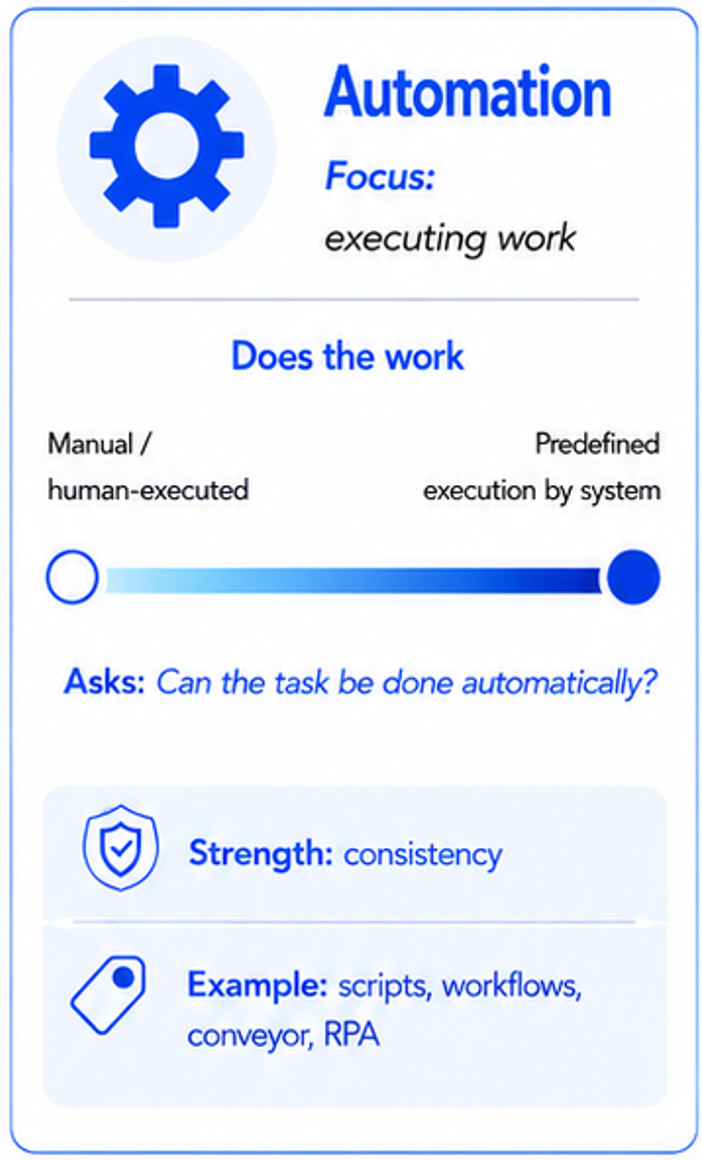
Automation is the ancient grandpa of modern industry, and despite what marketing pamphlets claim, it is not intelligent. Its primary focus is strictly executing work based on predefined instructions. An automated system takes an input and triggers an unchanging, rule-based output. It does not think, it does not pivot, it does not ponder life, and it certainly does not make choices. The core question automation asks is simple: Can the task be done automatically?
When we look at formal definitions, bodies like SAE International define driving automation in their J3016 standard as the use of electronic or mechanical devices to replace human labor. Because industrial and automotive sectors have been doing this forever, we have well-established, strict scales out there. SAE famously uses Level 0 (no automation) to Level 5 (full automation) to classify vehicle systems. In classic enterprise terms, this is your standard software script, an RPA workflow, or a physical warehouse conveyor belt. The greatest strength of automation is pure, unyielding consistency. If you give it the exact same input ten thousand times, it will execute the exact same sequence ten thousand times without a single variation. However, if the environment changes by even a millimeter, the automated system catastrophically breaks because it has absolutely zero internal capacity to adapt.
Agency: Choosing Actions
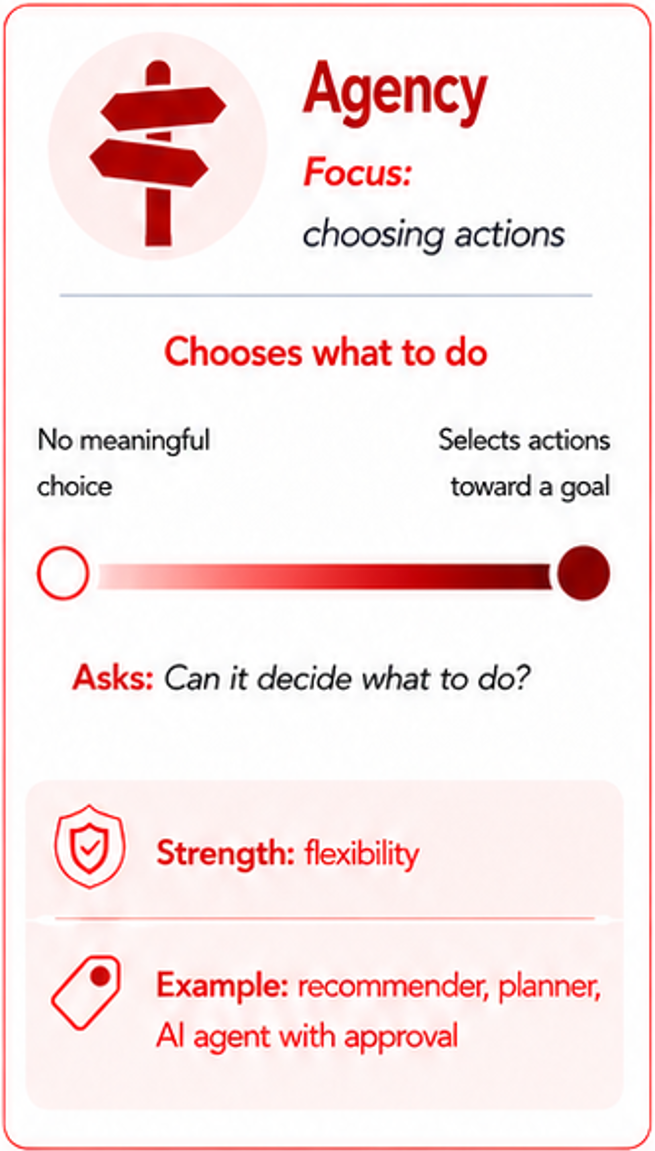
Agency introduces something entirely new to the architectural equation, which is choice. While automation is entirely about execution, agency is hyper-focused on choosing actions toward a specific goal. An entity with agency evaluates options and selects a path forward based on changing inputs. The core question agency asks is: Can it decide what to do?
The concept of machine agency has gained so much traction that the IEEE Standards Association developed IEEE 3152-2024, a formal standard specifically for human and machine agency identification. In that document, agency refers to the capacity of an entity, whether human, machine, or a hybrid combination, to initiate actions and make decisions independently, reflecting their respective abilities to exert influence and enact choices within their environments. Across academia and engineering, definitions of agency are remarkably similar: they all center on the capacity to act, evaluate, and choose. If you are looking for a scale, the IEEE 3152-2024 standard introduces specific classifications for clearly identifying who or what is the acting entity, ranging from pure organic humans to entirely AI-driven systems.
An AI agent that recommends a product, drafts a customized email, or suggests a supply chain pivot possesses agency. Its defining strength is flexibility. Instead of immediately breaking when a new variable is introduced, an agent looks at its available toolkit, weighs the potential choices, and decides on a response. However, high agency does not automatically mean the system is operating in complete isolation. You can easily have an AI agent with massive agency that still requires a human to hit an approval button before any action is finalized in the real world.
Autonomy: Independent Operation
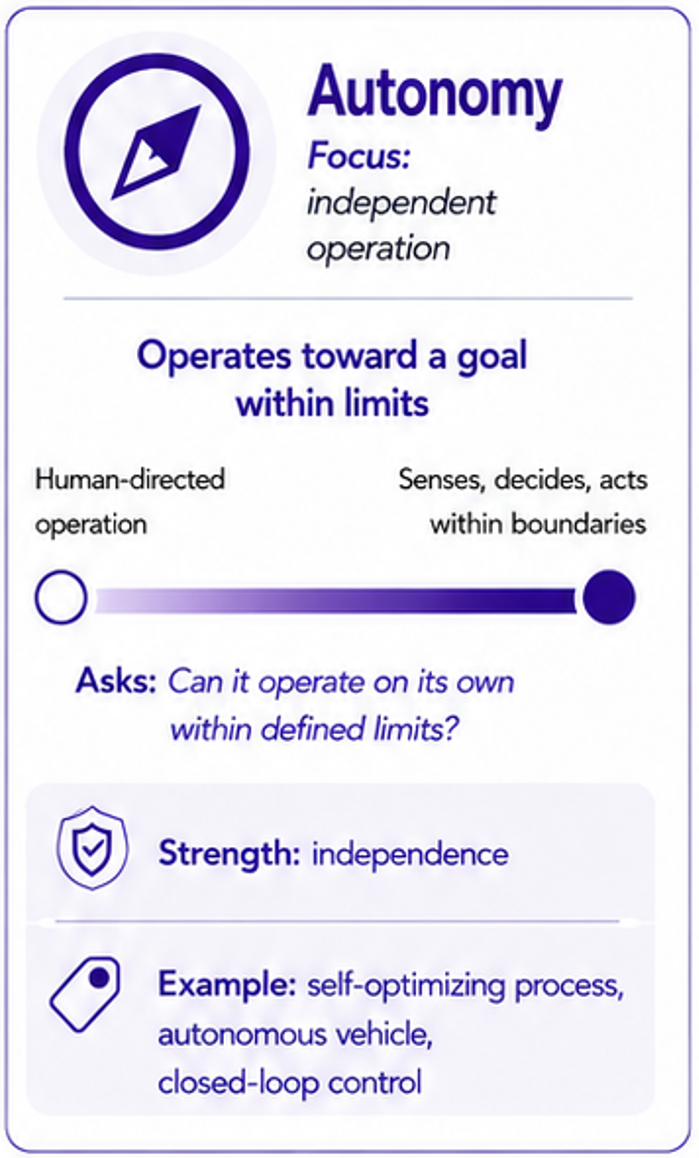
Autonomy is the final peak, and it is usually where the most painful confusion lies. Autonomy focuses on independent operation over an extended period. An autonomous system does not just execute a task or choose a single action; it operates toward a broad goal entirely within defined limits, without requiring continuous human direction or babysitting. The core question autonomy asks is: Can it operate on its own within defined limits?
Here is an interesting reality check for your next AI strategy meeting: if you dig into the archives of global standards organizations for a single, universally accepted, formal definition specifically for software or AI autonomy, you will quickly find that no single, formal software standard exists in the consensus way it does for physical robotics or vehicles. Instead, software folks tend to borrow definitions from the physical vehicle and drone industries, or adopt emerging taxonomies from groups like the Cloud Security Alliance (CSA) or independent software development frameworks.
The defining strength here is complete independence. Classic examples include an autonomous delivery vehicle navigating a chaotic city or a self-optimizing manufacturing facility that balances its own power usage and machine maintenance based on real-time market demand.
The 10 Levels of Automation (and the Confusion They Cause)
To understand exactly why people get so confused when discussing software agents, we have to look at the holy grail of human-automation interaction literature: the 10 Levels of Automation framework originally introduced by Sheridan and later expanded by Parasuraman, Sheridan, and Wickens (2000). This classic engineering model outlines a sliding scale of how much control moves from a human to a machine:
Level 1:The computer offers no assistance; the human must take all decisions and actions.
Level 2:The computer offers a complete set of decision/action alternatives.
Level 3:The computer narrows the selection down to a few options.
Level 4: The computer suggests one specific alternative.
Level 5:The computer executes that suggestion if the human approves.
Level 6:The computer allows the human a restricted time to veto before automatic execution.
Level 7:The computer executes automatically, then necessarily informs the human.
Level 8:The computer informs the human after execution only if explicitly asked.
Level 9:The computer informs the human after execution only if it, the computer, decides to.
Level 10:The computer decides everything and acts completely autonomously, ignoring the human.
This exact framework is precisely where the massive industry confusion begins. Because this scale is labeled a scale of automation, people mistakenly assume that pushing a system to "Level 10" is simply a matter of adding more automation.
But look closely at what changes as you move up those levels. Levels 2 through 5 are entirely about a machine evaluating alternatives and selecting options, which is the definition of agency. Levels 6 through 10 are about the machine executing loops over time without waiting for human intervention, which is the definition of autonomy.
The industry is using a legacy mental model where "automation" is treated as the blanket term for everything. In reality, a system cannot progress through these ten levels unless it leaves strict, rule-based automation behind and explicitly incorporates the building blocks of agency and autonomy.
How They Relate: The Dependency Logic
These terms are not mutually exclusive or warring factions. In fact, they build upon one another in a logical sequence. You can write the relationship as a simple equation:
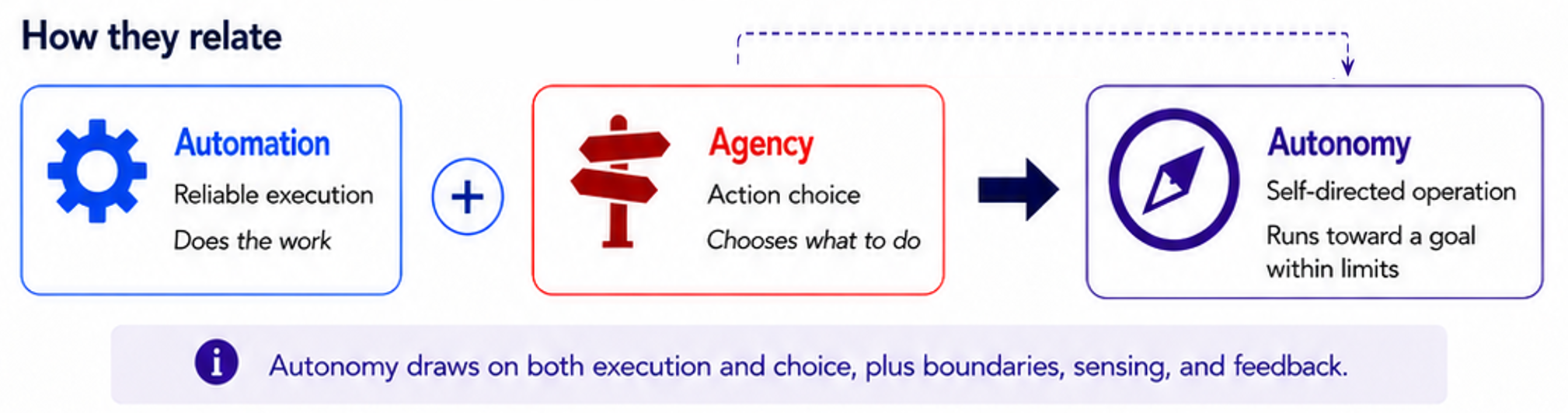
Autonomy cannot exist in a vacuum. It draws heavily on both execution and choice, but it layers on top a continuous loop of boundaries, sensing, reasoning, execution, and feedback. To build a truly autonomous system, you need all of these architectural building blocks working together in a tight, closed loop:
Boundaries: The system must clearly know its limits and stay safely within them.
Sensing: It must continuously perceive its surrounding context and environmental changes.
Reasoning: It must interpret data and actively plan its next steps logically.
Execution: It must carry out the chosen actions reliably.
Feedback: It must learn from the outcome and adapt for the next loop.
Automation can stand completely alone. You can have a script that copies data from one spreadsheet to another without any agency or autonomy. Agency can also stand alone. An AI assistant can give you three brilliant choices for how to handle a customer complaint, exercising its agency, without having the autonomy to actually send the email or execute the workflow. Autonomy, however, strictly requires both building blocks to function.
What People Often Miss
When building out an enterprise AI roadmap, there are three critical traps that leaders constantly fall into when they mix up these definitions.
First, more automation is not the same as more autonomy. You can string together a thousand automated steps in a row, but if the system cannot make an independent decision or adapt to a changing environment on its own, you have simply built a very long, incredibly fragile chain of automation. It will still break the moment a single real-world variable shifts unexpectedly.
Second, a system can choose wrongly or drift horribly without proper oversight and boundaries. When you grant an AI system agency, you are giving it the power to choose. If you do not wrap that agency in strict operational boundaries, the system can rationalize choices that are technically logical to its algorithm but completely catastrophic to your actual business goals.
Third, autonomy is defined by reliable outcomes, not by the total absence of people. True autonomy does not mean you fire your entire team and let the machines run wild in the dark. It means the system is robust enough to handle the loops of sensing, reasoning, and acting so that your human talent can finally shift from manual execution to high-level governance and strategic oversight.
What to Do Next: Your Action Plan
The next time a vendor or internal team pitches an "agentic AI" solution, do not nod along to the marketing slide. Stop the presentation and audit the architecture by asking three direct questions:
Audit the Choices (Agency): Does this system actually generate dynamic choices based on unstructured variables, or is it just a complex, nested if/then script? If it doesn't navigate choices, it is just automation.
Audit the Hand-offs (Autonomy): Where does the human sit in the loop? If the system has high agency but requires a human to explicitly click "approve" on every single sub-task, acknowledge that you are deploying scoped agency, not a self-contained autonomous worker.
Audit the Guardrails (Boundaries): If you are granting it autonomy, what are the hard bounding parameters? What is the automatic tripwire that forces the AI to throw its hands up and page a human auditor?
Knowing the difference between execution, choice, and independent operation is exactly how we move past the ridiculous marketing hype and start building actual, defensible software architecture.
References:
Cloud Security Alliance. (2026). Autonomy levels for agentic AI. Cloud Security Alliance Blog. https://cloudsecurityalliance.org/blog/2026/01/28/levels-of-autonomy
IEEE Standards Association. (2024). IEEE standard for transparent human and machine agency identification (IEEE Std 3152-2024). IEEE. https://standards.ieee.org/ieee/3152/11718/
Parasuraman, R., Sheridan, T. B., & Wickens, C. D. (2000). A model for types and levels of human interaction with automation. IEEE Transactions on Systems, Man, and Cybernetics - Part A: Systems and Humans, 30(3), 286-297. https://doi.org/10.1109/3468.844354
SAE International. (2021). Taxonomy and definitions for terms related to driving automation systems for on-road motor vehicles (Standard No. J3016_202104). SAE International. https://www.sae.org/standards/content/j3016_202104/