The Law of Conserved Indecision
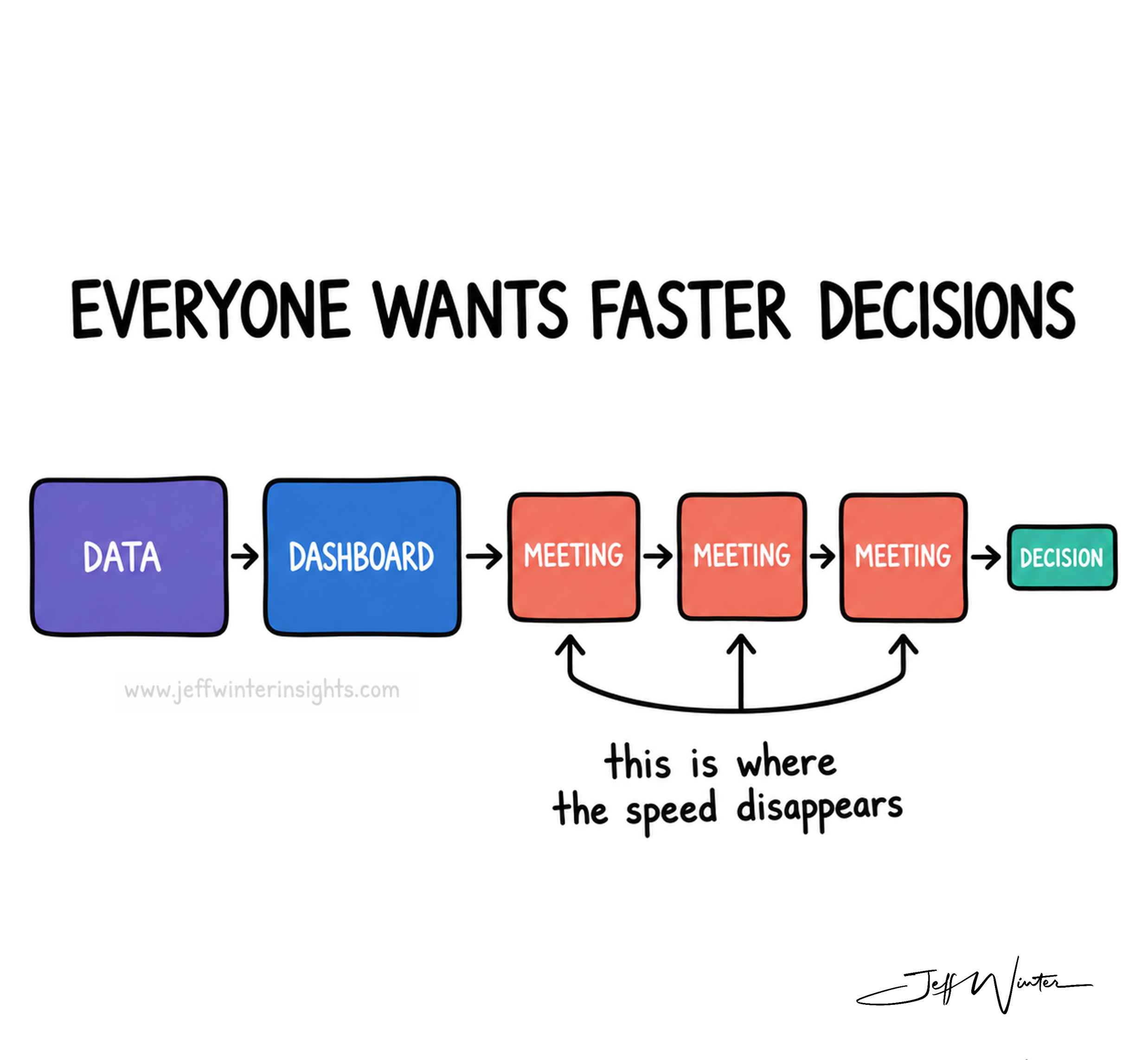
I’ve always loved physics... or at least understood enough to create questionable corporate analogies. Which brings me to the Law of Conserved Indecision: Any time eliminated through technology must immediately reappear somewhere else as a meeting. Consider it my highly unscientific contribution to management theory. Indecision cannot be created or destroyed; it can only be converted into a recurring calendar invitation. 😂
We connect the systems, clean the data, automate the analysis, and deliver the answer in real time. Then we gather everyone important to admire how quickly it arrived. Three people can stop the decision, six need to “weigh in,” and someone was invited because being excluded would require another meeting. The dashboard refreshes every five seconds. The approval process refreshes every other Thursday, assuming everyone is available. We have somehow built organizations where information travels at machine speed and permission travels at the speed of finding a mutually convenient time.
Data speed ≠ decision speed.
Technology can reduce the delay between something happening and us knowing about it. Reducing the delay between knowing and acting also requires clear authority, accountability, and conditions for action. Otherwise, better information can become a larger collection of evidence for people to interpret, debate, and selectively weaponize.
A 2025 study by Microsoft and Harvard researchers makes this distinction tangible. In a six-month randomized experiment involving 7,137 workers across 66 firms, access to an AI assistant reduced email time by about 1.3 hours per week on average. The estimated reduction for regular users was 3.6 hours, or 31%, with suggestive evidence of faster document completion. Time spent in meetings showed no statistically significant change. The gains concentrated in work people could change independently; coordinated work proved harder to shift. The experiment did not establish that saved time became meetings, and it studied an early rollout with limited access across teams. My takeaway is that individual efficiency can improve while organizational habits remain stubbornly intact. This problem predates generative AI. In McKinsey’s 2019 survey of more than 1,200 managers, 61% said at least half their decision-making time was ineffective. Fewer than half considered decisions timely. Apparently, we had already mastered artificial delays before artificial intelligence arrived.
Give the decision somewhere to go
There may even be a reason our fixes keep making the process heavier. A 2021 Nature study, spanning eight experiments, found that people systematically overlooked useful changes involving subtraction. Applying that insight to organizational life, I suspect “add another approval” comes to mind more readily than “remove an approval.” Nobody gets to chair the committee we successfully avoided creating.
Start by eliminating recurring meetings whose primary purpose is presenting or reviewing data that people can access beforehand. Preserve shared time for interpreting genuine uncertainty, resolving competing priorities, and making consequential choices. A roomful of expensive people watching someone read a dashboard aloud is a surprisingly elaborate way to distribute a link.
Then build the decision rules directly into the operating process. Specify what triggers action, who owns the decision, whose input is necessary, how quickly a response is required, and where exceptions escalate. Make the distinction between contributing expertise and holding approval authority explicit. Being consulted should come with a clear opportunity to contribute and a deadline.
Imagine a manufacturer detecting a likely equipment failure. The alert becomes useful when the maintenance lead has authority to schedule an intervention within agreed cost, production, and safety limits. Routine work can proceed through predefined rules, with appropriate checks. Decisions exceeding those limits reach the named escalation owner promptly, with the unresolved tradeoff already identified. Everyone wants faster decisions until faster decisions mean someone else gets to make them. Leaders have to honor the authority they delegate. If employees are punished whenever a reasonable decision produces an imperfect outcome, requesting six approvals becomes a sensible survival strategy. Evaluate the quality of their judgment against the information and boundaries available at the time. Otherwise, your empowerment initiative will quietly become a permission-seeking competition.
Finally, measure the entire journey from signal to action. Track how long decisions wait after sufficient information is available, how often they escalate, and whether they produce the intended outcome. Review errors and rework alongside speed, because a fast mistake repeated automatically is hardly a productivity breakthrough. AI raises the stakes because it can generate recommendations faster than an organization can absorb them. Without changes to decision rights and workflows, we risk building a remarkably efficient system for producing things that await approval. Everyone gets a better assistant, and the bottleneck gets a bigger inbox.
I would love to see someone disprove my Law of Conserved Indecision. Give people the information, authority, and boundaries to act, then let them use the time they saved. Just please don’t establish a steering committee to investigate the possibility.
References:
Adams, G. S., Converse, B. A., Hales, A. H., & Klotz, L. E. (2021). People systematically overlook subtractive changes. Nature, 592(7853), 258–261. https://doi.org/10.1038/s41586-021-03380-y
De Smet, A., Jost, G., & Weiss, L. (2019, May 1). Three keys to faster, better decisions. McKinsey & Company. https://www.mckinsey.com/capabilities/people-and-organization/our-insights/three-keys-to-faster-better-decisions
Dillon, E. W., Jaffe, S., Immorlica, N., & Stanton, C. T. (2025). Shifting work patterns with generative AI (Working Paper No. 33795). National Bureau of Economic Research. https://www.hbs.edu/ris/Publication%20Files/w33795_dd1e2857-d195-4333-86ba-6a8953119ed4.pdf