Everybody wants to put AI into everything. The product. The sales process. Customer service. The meeting about where to put AI. We can find a use for it almost anywhere, which makes it surprisingly easy to fill an entire strategy presentation without deciding what the company is actually trying to achieve.
“We should improve forecasting.” Absolutely. “Also personalize the customer experience.” Makes sense. “Also automate finance, help engineering, and launch an AI service.” All potentially good ideas! Then someone asks who will do the work, and everybody looks at the same three people. (Ah yes, the three people with all that spare time. I've heard wonderful things about them.)
I understand the excitement. I share it. I work on business strategy and industrial technology; give me a demonstration of something useful and I will happily start imagining what else it could do. That's part of the fun. But somewhere between the demonstration and the budget request, I want us to answer a less entertaining question: why should THIS get our best people and biggest commitment?
AI's capabilities have expanded. Your resources haven't magically expanded with them.

That's why I created the six-route graphic. A pile of sensible projects can still leave a company stretched thin, with no clear reason customers should prefer it over a competitor. We don't need to find bad ideas to waste effort. We can do that perfectly well by saying yes to too many good ones. The research gives us reason to be selective. In McKinsey's 2025 global AI survey, 88% of respondents reported regular AI use in at least one business function, while 39% reported any enterprise-level EBIT impact, meaning an effect on earnings before interest and taxes. Those are separate measures, not a diagnosis of why any particular company struggled. But they show how different “we use AI” and “AI is affecting company earnings” can be. BCG's 2025 study of more than 1,250 firms found only 5% achieving AI value at scale, with 60% reporting minimal revenue and cost gains.
I grouped the choices into six areas: products and services, operations, employee empowerment, customer experience, innovation, and business models. This is my way of organizing where to focus, informed by research and the questions I ask about strategy. The routes overlap, and they deserve very different amounts of investment depending on the company. Six boxes on a graphic do not mean six equal budgets. Please don't give the graphic that kind of authority.
Products and services
Would somebody choose your product because of what AI enables it to do?
I would ask that before adding another feature, even if the feature looks fantastic on stage. Maybe a conversational interface helps customers configure a complicated product. Maybe it gives them a new way to wrestle with a menu we should have fixed years ago. I want to know which situation we're in before we put “AI-powered” on the website and order the launch cupcakes.
The three branches here are intelligent features, predictive services, and autonomous functionality. Think of software that helps someone complete difficult work correctly, a service that spots a developing equipment failure, or a machine that adjusts its behavior within defined operating limits. In each case, the AI should improve something the customer cares about enough to influence a buying decision, a renewal, or what they're willing to pay. My industrial technology brain goes straight to the operating problem. What becomes more reliable? What expertise does the customer no longer need at every location? Can they maintain quality as conditions change? Those questions make the feature discussion much more interesting to me, because now we're talking about what happens after the demonstration.
Then comes the slightly annoying part... competitors can buy models too. McKinsey's 2026 work on AI competition points to data competitors cannot easily access and the ability to put technology to work. I agree with that direction. Useful field data, knowledge of a process, and an installed base give a product team something to build on. They don't guarantee success. They do give us a better starting point than assuming access to the same model everyone else can buy makes us special.
Operations
There is something deeply satisfying about an improvement that customers barely notice because everything simply works. The order arrives when promised. Quality is consistent. Nobody has to explain why a small change requires three weeks and an apology. Behind that experience, AI might be helping with end-to-end automation, resource optimization, quality and reliability, or forecasting and decisions.
Let me invent a planning project for a moment. The new AI tool generates a schedule in minutes. You can question it, change assumptions, compare scenarios. I would absolutely want to see that demo. Now follow the schedule into the operation. The inventory record is wrong. One machine can't run at its assumed rate. Sales promised something nobody entered into the system, and an approval has been sitting in an inbox since Tuesday. By the time the plan reaches the floor, a supervisor has rebuilt half of it in a spreadsheet.
The planning task got faster. What happened to delivery? Uh oh…This question changes the assignment. We have to examine the information going in, who can act on the output, and what happens when reality refuses to follow the plan. Some of the improvement may require changing an approval, fixing a handoff, or giving someone permission to make a decision. Some may come from better scheduling without AI. Fine by me! I don't need the algorithm to receive all the credit. This is why I would trace an important workflow all the way through, from the original request to the completed job. Include the exceptions and the rework, especially the parts everyone leaves out of the demonstration. Then decide where AI can help. Cost per completed job, delivery reliability, yield, and throughput can show whether the operation improved. A count of automated steps tells us much less.
Also, please include the work created elsewhere! If one team's time savings depend on another team spending every afternoon reviewing exceptions, we need both sides of that calculation. I would happily celebrate a modest improvement we understand. A spectacular efficiency claim that depends on ignoring the cleanup is going to have a very short celebration.
Employee empowerment
The employee research makes me optimistic, and a little impatient with the idea that buying everyone the same assistant is a complete plan. Brynjolfsson, Li, and Raymond studied 5,172 customer-support agents in research published in The Quarterly Journal of Economics in 2025. AI assistance increased issues resolved per hour by 15% on average. Less experienced and lower-skilled workers improved in speed and quality; the most experienced, highest-skilled workers saw much smaller speed gains and some quality declines. That was one firm, so we shouldn't copy its results into our own business case and call the analysis finished.
The differences are what interest me. Imagine a service business struggling to find experienced technicians. Helping newer employees get up to speed could change how much work the company can take on. A senior specialist may need something quite different, perhaps help searching a large technical record or testing alternative explanations. Same company, different needs. One adoption target won't tell us much about either.
I split this route into expertise on demand, and creation and problem-solving. People can get help finding and applying knowledge, or use AI to develop ideas and work through difficult questions. That still requires judgment. An experiment involving 758 BCG consultants found GPT-4 users completed suitable tasks 25.1% faster, but AI use reduced correctness on a complex task outside its capabilities. Published in Organization Science in 2026, it tested a particular model and set of tasks. It gives us a good reason to test the work we actually want people to do; it doesn't tell us how every assistant available today will perform.
And after we save the time... where does it go? We could spend more of it with customers, test designs sooner, or accept work we previously had to turn away. We could also fill it with more reporting and meetings. (Please let us resist the urge to celebrate saved time by scheduling a recurring meeting about it.) For a company that competes through expertise, this could deserve the largest investment of the six. I'd want managers to explain how better individual work changes company performance. “Everyone has a license” is easy to report. I'm much more interested in what people can now accomplish with it.
Customer experience
Try buying from your own company. Then change the order. Then ask for help when something goes wrong. If the exercise takes the rest of the afternoon, you may have found your starting point.
Personalization, proactive support, and frictionless buying are the branches here. They solve different problems. McKinsey's 2021 consumer research found 71% expected personalized interactions and 76% became frustrated when they didn't receive them. That's older research, and I include it because the customer need existed well before the generative AI rush. It cannot tell us the return on a new AI project. We still have to work out which interaction needs attention: finding a suitable product, preventing a service issue, or completing a purchase without repeating the same information four times.
My patience for a fast answer disappears pretty quickly if it doesn't resolve anything. A bot can respond instantly and leave the customer exactly where they started, only slightly angrier. I would judge this route by whether people get what they need, how much effort it takes, and whether they want to come back. The speed of the greeting is a fairly small part of that story.
Innovation
The finished product might contain no AI at all. The company may still have used AI to develop it sooner, spend less testing weak ideas, or find something it otherwise would have missed. That's why innovation gets its own route, with research and discovery alongside design and experimentation.
Consider AlphaFold. Google DeepMind and EMBL-EBI have made more than 200 million predicted protein structures openly available. Those predictions can help researchers decide which experiments to pursue. They still require testing; this is not a collection of 200 million experimentally validated structures or successful drugs.
What excites me is the possibility of investigating questions a team previously couldn't afford to explore. But judging the work takes some thought. A thousand generated concepts can make a progress report look busy. Discovering that a favorite idea won't work could save far more money, even though it makes for a much less cheerful slide. I'd want leaders to reward that discovery. Otherwise, we risk giving teams a faster way to supply ideas to a development process that already struggles to stop anything. Someone eventually has to say, “We learned enough. Let's move on.” AI can help us learn; it won't automatically make us less attached to the project we named ourselves.
Business models
Open the spreadsheet for this one. The version with delivery costs in it, please. 🤣
AI could make a service economical at a volume or price point that previously didn't work. It could support outcome-based offerings or strengthen a data and platform business. Those are the graphic's three branches: services at software scale, outcome-based offerings, and data and platform businesses.
MIT CISR research, summarized by MIT Sloan in January 2026, describes businesses moving from augmenting existing activities toward acting for customers and assembling services around their goals. Their categories differ from mine, but the work raises a question I find compelling: could AI change the role our company plays for the customer? I can get carried away with that question. Then I want to know who gets the money. If a service becomes cheaper to deliver, perhaps we retain more margin. Perhaps we reach customers we couldn't profitably serve before. Or competitors make the same improvement, prices fall, and customers capture much of the benefit. All of those possibilities deserve attention before we congratulate ourselves on the new business model.
Selling an outcome needs particular care. We might promise availability or performance, but how much control do we have over the result? What happens when the equipment operates outside agreed conditions? How often will a supposedly scalable service need expensive human intervention? A monthly invoice won't work out the answers for us. This is where sales incentives, service capacity, contracts, and financial risk enter the discussion. I like ambitious ideas. I like them even more when someone has worked through what it will cost to keep the promise. The equipment-maker example below shows why I would want several departments in that conversation from the beginning.
Four examples of making a choice
I invented the four companies in the graphic to show how different businesses might choose where to invest. These are illustrations, not reports of measured results. Each has a reason for its choices, and some combine more than one branch. Being selective doesn't mean every company is allowed exactly one colored box.
The logistics provider
Start with blue. This provider wants to deliver reliably at a lower cost. End-to-end automation helps order information move into execution; resource optimization helps allocate fleet capacity. For a company with useful operating data and the ability to coordinate its network, the two investments can support each other. Automate order entry while leaving capacity poorly allocated and you may simply move the problem along faster. Optimize against incomplete orders and the plan has a different problem. I'd examine cost per shipment alongside service performance, because a cheaper delivery that misses the required window may be a remarkably expensive saving. The choice earns its place through that connection. Both branches serve the same delivery promise, and the provider has a plausible way to act on them. That's a much better explanation for funding both than “operations wanted two projects.”
The retailer
The orange example is narrower: personalization. Suppose repeat purchases matter greatly to a retailer's profit. It knows customers' preferences, has permission to use the information, and can make useful recommendations. Helping people find something they want could give them a reason to return. That may deserve most of the retailer's AI budget for now. I'd be careful with the results, though. Recommending something a customer was already going to buy can produce a lovely dashboard. So can offering a discount big enough to wipe out the margin. Compare against an appropriate control group, count the discounts, and look at margin and repeat purchasing. I'd like to know whether we earned additional business... preferably some that made money.
The biotech company
Navy goes to research and discovery. Imagine a biotech company with proprietary experimental data, specialist knowledge, and limited lab capacity. Better candidate selection could matter far more than saving a few minutes on many office tasks. Scientists can make predictions, test them, and use the results to choose the next experiment. Experimental validation and the further evidence needed to develop a medicine still apply. I chose this example because it makes the resource constraint so clear: the lab can only test so much. A faster presentation about a weak candidate will not create another lab.
The equipment maker
This example needed two colors. Purple connects predictive services within products and services; red connects outcome-based offerings within business models. The company wants to compete on equipment uptime, so technical and commercial decisions have to work together. Predicting a failure becomes valuable when the provider can respond. That could mean intervening before an outage, arranging maintenance at a better time, or understanding the likely cost of an uptime commitment. An offer tied to availability gives those investments a shared customer promise. It also gives the company a financial reason to care whether the predictions lead to useful action.
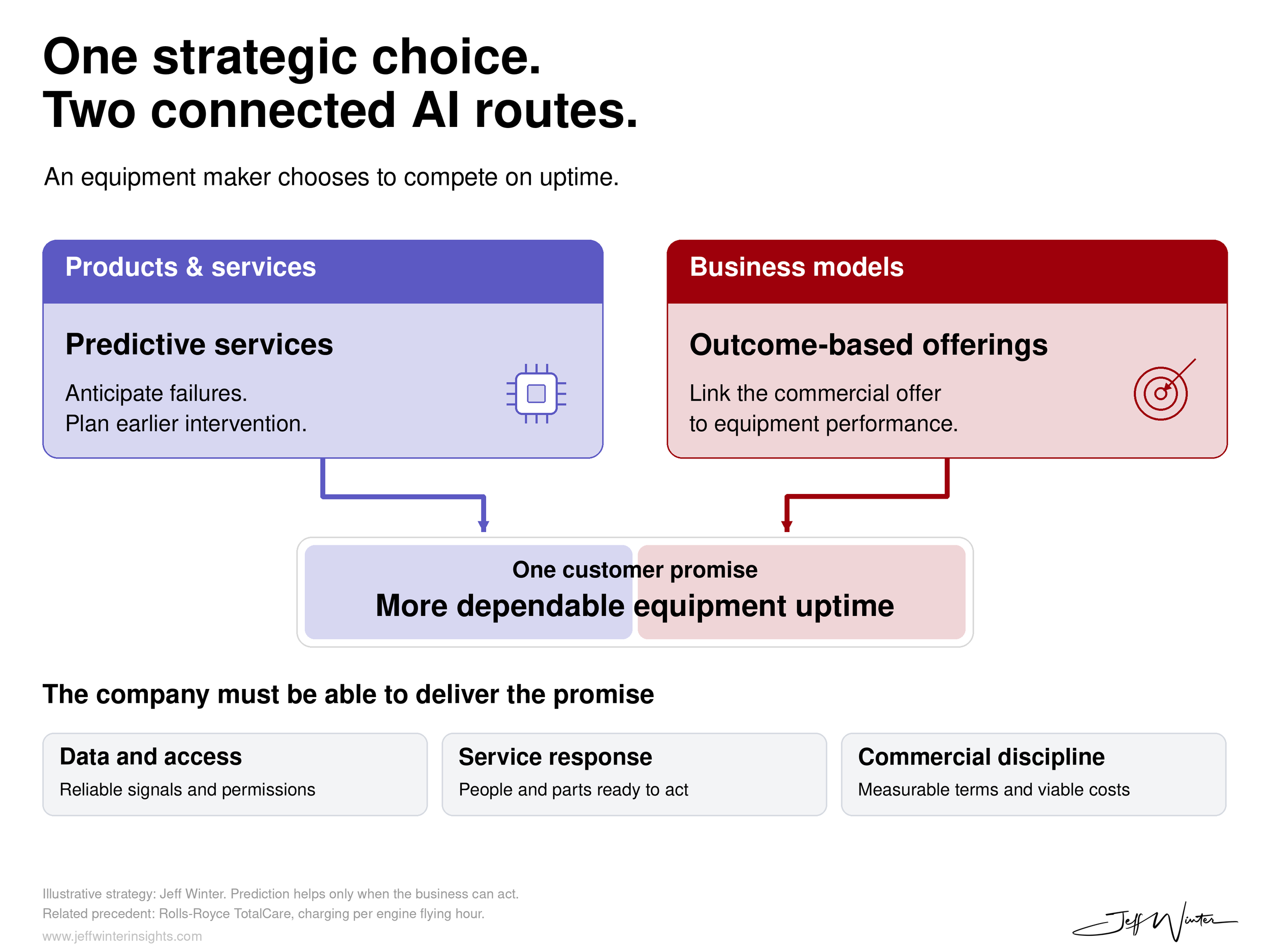
There is precedent for the commercial idea. Rolls-Royce describes TotalCare as charging per engine flying hour, aligning its interests with customers by keeping engines in service. Its explanation connects proactive maintenance with operating data and advanced analytics. AI didn't invent selling an outcome. It can strengthen our ability to understand and deliver one, provided the rest of the business can support it. And there is quite a lot in “the rest of the business.” Parts must be available. Someone needs to respond. The customer has to provide the agreed data and operating access. The contract needs to reflect risks we can reasonably manage. An accurate warning won't help much if the required part arrives three weeks after the equipment stops. (Wonderful. We predicted the outage perfectly. I'm sure the customer will want to frame the chart.)
This is why I spend more time on this example. Product development, service, sales, and finance have to work through the same promise. I'd review uptime, service cost, renewals, and contract profitability together. Otherwise, one team can celebrate the sale while another inherits an obligation it can't deliver economically. Two highlighted paths make sense when we are willing to fund and coordinate all that work.
What deserves the biggest commitment
If I took the six-route graphic into a leadership meeting, I'd resist the urge to start filling it with ideas. The room probably has plenty already. I'd first ask what we want to improve for customers, why we think we can do it better than competitors, and what evidence supports that belief.

The matrix below helps with that discussion. It isn't a scoring model. A benefit may matter greatly to customers while we lack the data or skills to deliver it, which could justify a focused experiment or a partnership. Another idea may be easy to build and do very little to influence customer choice. The fact that we can finish it quickly is useful information. It doesn't automatically deserve the largest budget.
Once we choose, I want the conversation to get specific:
Who owns the business result after the demonstration?
Which people and resources will we commit?
What work will we defer to make room?
What evidence would make us expand, change course, or stop?
That third question is where I would slow down. If we add the AI priority and leave every existing commitment in place, we've handed someone an extra job and called it strategy. I would want to see what comes off the list, who agrees to it, and whether the people doing the work believe the plan is possible. I still want experimentation! Give people access to the tools and room to discover things leadership hasn't imagined. We can encourage that while putting most of our resources behind a few choices. The trouble comes when every experiment becomes permanent, every department gets another initiative, and nothing ever loses its place on the agenda.
AI gives us an enormous list of things we could do. I made this graphic to help decide what we will actually commit to doing well. So before we add one more promising idea, I'd like us to finish a sentence that rarely gets as much enthusiasm: “For now, we're going to leave this one alone.”
And then leave it alone. Even if the next demo has a better animation.
References:
Apotheker, J., Beauchene, V., de Bellefonds, N., Forth, P., Franke, M. R., Grebe, M., Kataeva, N., Kirvelä, S., Kleine, D., de Laubier, R., Lukic, V., Luther, A., Martin, M., Walters, J., & Schweizer, C. (2025, September 30). The widening AI value gap: Build for the future 2025. Boston Consulting Group. BCG
https://www.bcg.com/publications/2025/are-you-generating-value-from-ai-the-widening-gapArora, N., Ensslen, D., Fiedler, L., Liu, W. W., Robinson, K., Stein, E., & Schüler, G. (2021, November 12). The value of getting personalization right—or wrong—is multiplying. McKinsey & Company. McKinsey
https://www.mckinsey.com/capabilities/growth-marketing-and-sales/our-insights/the-value-of-getting-personalization-right-or-wrong-is-multiplyingBrynjolfsson, E., Li, D., & Raymond, L. (2025). Generative AI at work. The Quarterly Journal of Economics, 140(2), 889–942. doi.org
https://doi.org/10.1093/qje/qjae044Dell’Acqua, F., McFowland, E., III, Mollick, E., Lifshitz, H., Kellogg, K. C., Rajendran, S., Krayer, L., Candelon, F., & Lakhani, K. R. (2026). Navigating the jagged technological frontier: Field experimental evidence of the effects of artificial intelligence on knowledge worker productivity and quality. Organization Science, 37(2), 403–423. Organization Science
https://doi.org/10.1287/orsc.2025.21838Diedrich, D., Williams, E., Catlin, T., & Fountaine, T. (2026, May 15). From AI table stakes to AI advantage: Building competitive moats. McKinsey & Company. mckinsey.com
https://www.mckinsey.com/capabilities/quantumblack/our-insights/from-ai-table-stakes-to-ai-advantage-building-competitive-moatsEastwood, B. (2026, January 12). How digital business models are evolving in the age of agentic AI. MIT Sloan School of Management. MIT Sloan
https://mitsloan.mit.edu/ideas-made-to-matter/how-digital-business-models-are-evolving-age-agentic-aiGoogle DeepMind, & EMBL-EBI. (n.d.). About. AlphaFold Protein Structure Database. alphafold.ebi.ac.uk
https://www.alphafold.ebi.ac.uk/aboutRolls-Royce. (n.d.). TotalCare. Rolls-Royce
https://www.rolls-royce.com/media/our-stories/discover/2017/totalcare.aspxSingla, A., Sukharevsky, A., Hall, B., Yee, L., Chui, M., & Balakrishnan, T. (2025, November 5). The state of AI in 2025: Agents, innovation, and transformation. McKinsey & Company. McKinsey
https://www.mckinsey.com/capabilities/quantumblack/our-insights/the-state-of-ai-2025